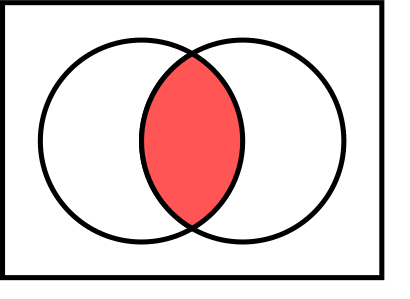
(http://upload.wikimedia.org/wikipedia/commons/9/99/Venn0001.svg)
Next we talked about disjunction, which is close to conjunction except whenever one of the two statements is true, the disjunction is true. Disjunction can be seen as the union of the statements, and the symbol for disjunction is v. Disjunction is false only when both statements are false, it is true whenever one of the statements is true.
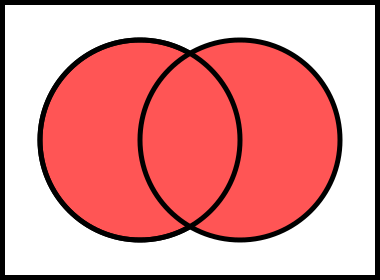
(http://upload.wikimedia.org/wikipedia/commons/3/30/Venn0111.svg)
Next up we talked about negation, negation is saying something opposite of a statement, it can be represented with NOT(statement), or ¬. Negation of the statement A is ¬A. An example of negation "All ferrari are red": we want to say something opposite of the statement "All ferrari are red", what is the opposite for the statement? "there are some ferrari that's not red" In venn diagram, negation can be represented as everything that's not the statement.

When we are depicting the truth value of only two statements, it can be easily done with a venn diagram, however, when we increase the number of variables, venn diagrams can be a real pain, it is too messy to see the truth value of a specific combination.

(http://www.newscientist.com/data/images/ns/cms/mg21528774.800/mg21528774.800-2_500.jpg)
It is beautiful, but it convey the truth value in an efficient fashion. Therefore, when we increase the number of statements or variables, we need a better way to show the truth value beside a venn diagram. This is when truth table comes into play.
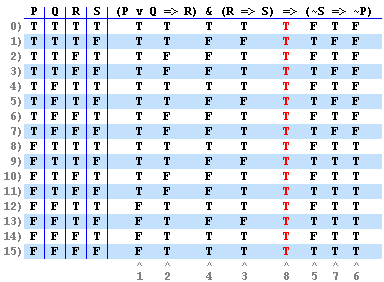
In the truth table, the truth value of some function can be easily found. Truth tables seek to enumerate over the outputs of all possible combinations of inputs. In a truth table, the number of rows is directly exponential to the number of inputs.
In the end we talked about laws and manipulations. They are like laws in math, but with boolean algebra, an example of the laws would be demorgan's law.

No comments:
Post a Comment